Heavy Rain & Thunderstorms Coming Tonight

An upper-level trough center over the Great Lakes will be taking a negative tilt today and tomorrow. At the surface, a low moving northward into Great Lakes,  will push a warm front will slowly across the Northeast. Rain over Pennsylvania this morning is well ahead of the this warm front and will likely break up somewhat as it comes east into stronger high pressure. But some intermittent rain or scattered showers are still possible during today, for the entire Tri-state area.

Tonight and tomorrow morning, things get more interesting. The upper-level trough takes a negative-tilt and a secondary area of low pressure develops along the warm front. This will lead to stronger southeast flow, pumping a copious amount of moisture from the Atlantic into the tri-state area. Precipitate water values will increase to 2.00″ or higher. Lifting along warm front will be enhanced by two divergent upper-level jet streaks, a strengthening low-level jet and increasing convergence with secondary low acting as a triple-point. Elevated instability will be on the increase MUCAPES are forecast to be between 500 J/kg to 1000 J/kg, early tomorrow morning. This will result area of heavy rain and embedded thunderstorms moving across the area.
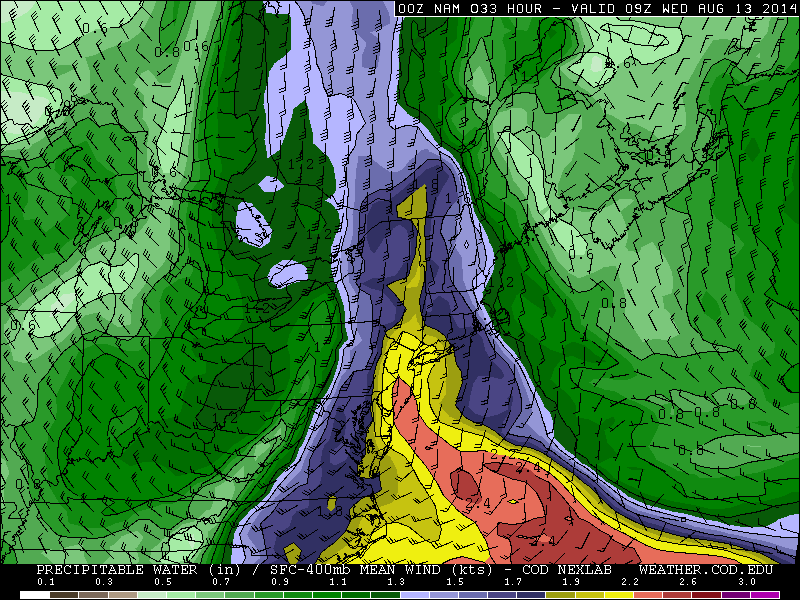
The 0z NAM showing precipitable water values near 2.00" or higher late tonight with the deep southerly flow.
The 0z NAM showing precipitable water values near 2.00″ or higher late tonight with the deep southerly flow.

Rainfall totals of at least 1 to  2 inches are likely for many areas. Some locally higher totals are possible, where thunderstorms train. Orographic lifting with the southeast flow may also aid areas inland areas receive between 2 to  4 inches of rainfall. For those reasons, the National Weather Service have issued Flash Flood Watches for parts of the region. Heavy rain could fall in a short period of time, resulting in flooding on roadways, poor drainage and low-lying areas.  Flooding near small streams and rivers is also possible.
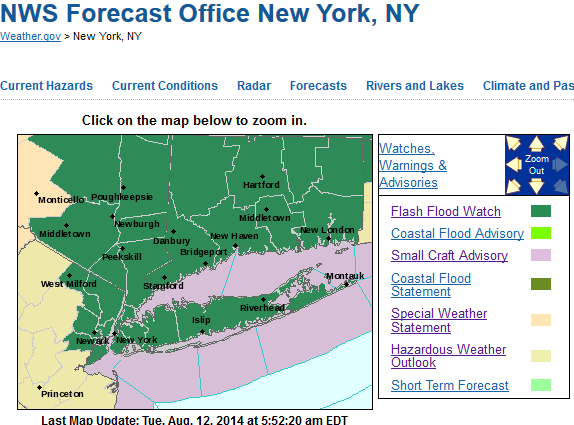
Flash Flood Watches in Green by the National Weather Service
Flash Flood Watches in issued by the National Weather Service

At this time, severe thunderstorms are not anticipated. There will be 30-40kts of 0-6km  shear. Helicity values will increase to near 500  m2/s2.  Lifting condensation levels will also be low. But with the secondary/triple-point low tracking mostly south and east of the area, during the early morning hours, low-level instability looks marginal at best. The threat for thunderstorms to produce a damaging wind gust or a weak tornado, appears to be extremely low and isolated in the Tri-state area. This threat will increase somewhat as head further south and west in Mid-Atlantic region, where instability could be higher.

Heavy rain and thunderstorms should taper to scattered lighter showers during the midday hours tomorrow, as the lifting with the warm front shifts north and east. There is chance clouds break for sunshine in parts of the area, by late tomorrow afternoon. Thursday and Friday are looking dry and with temperatures in the upper 70s or lower 80s. Which is slightly below normal for this time of year. However, a warming trend should be this weekend, with a southwest flow sending high temperatures pushing into lower to middle 80s.
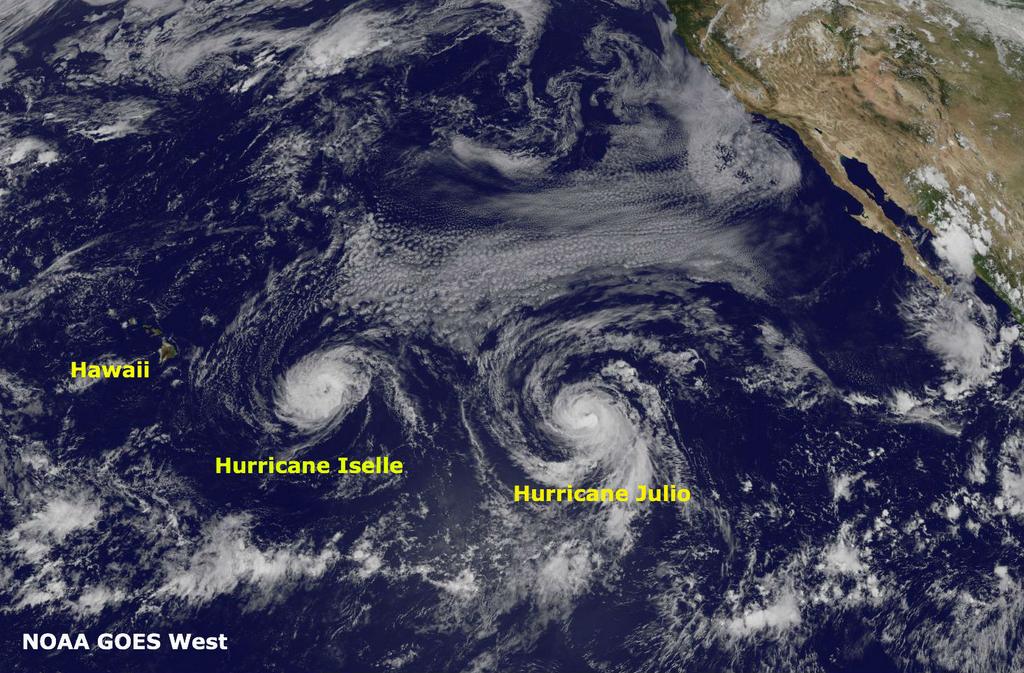
Hurricanes Iselle and Julio Threaten Hawaii

Usually we are talking hurricanes in the Atlantic. Since there are often a threat to the US mainland. But our long-distance have two hurricanes two hurricanes be concerned about in East Pacific. The first is named Iselle. The second behind it is named Julio.

Image courtesy of NOAA

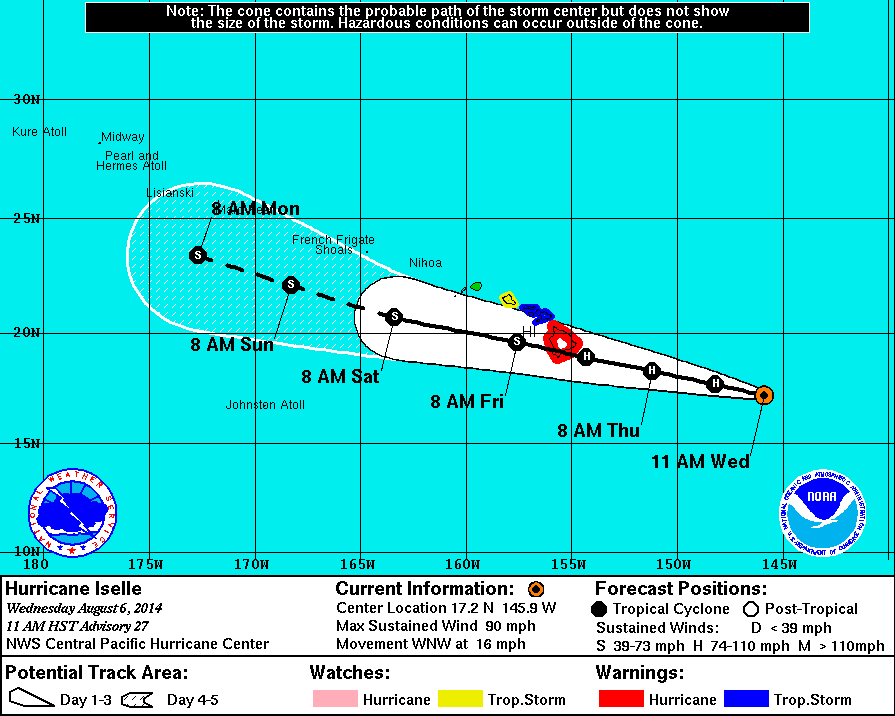
Hurricane Iselle has a triggered the first hurricane warning, in many years for Hawaii. As of 11am HST, Iselle is about 625 miles east-southeast of Kilo, Hawaii, on the biggest island and is moving west-northwest at 16mph. Maximum sustained winds are 90mph. Often hurricanes coming from the west weaken due to cooler waters and high shear environment closer to Hawaii Islands. However, Iselle as actually done the opposite today as shear remains light over it. Some weakening down to a tropical still expected as Iselle get closer to Hawaii. But out of caution, the Central Pacific Hurricane Center has a hurricane warning, for the biggest island. Their forecast track takes the center right over the island.

11HST forecast from the Central Pacific Hurricane Center
11am HST forecast from the Central Pacific Hurricane Center

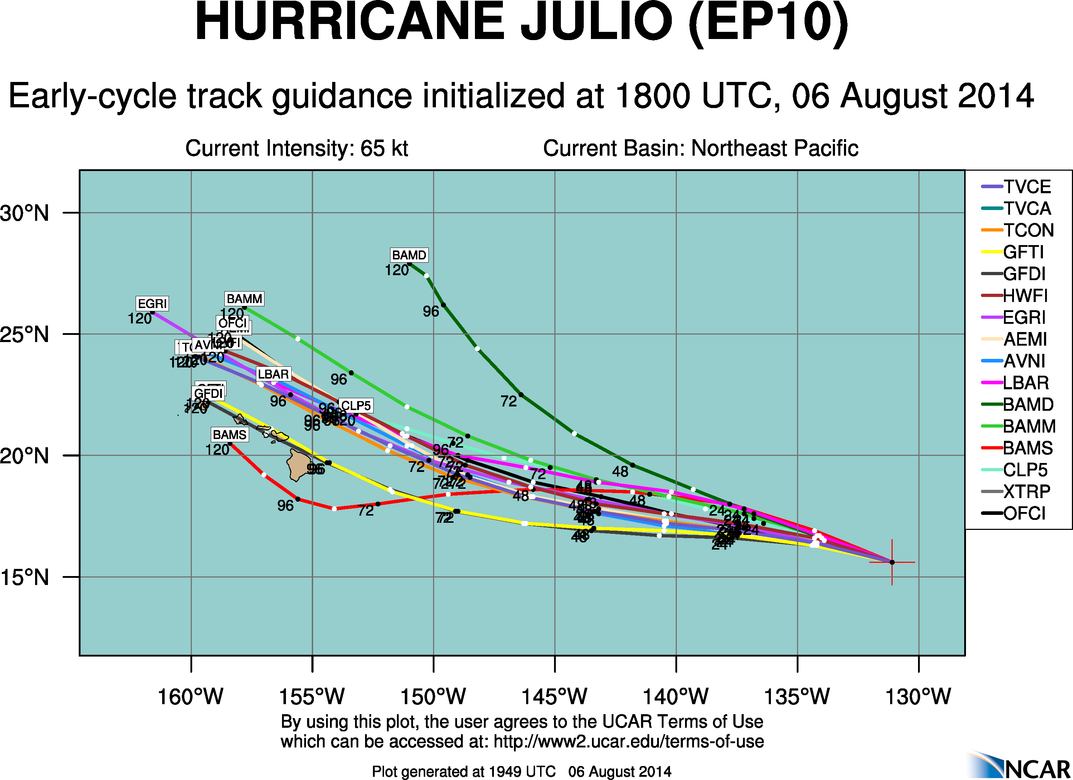
As of 2pm PDT, Julio is minimal hurricane with winds at 75mph. Current forecast Julio’s center moving north of Hawaii. Julio could be a threat in about 3-4 days. The track of Julio will dependent on how much of weakness in the ridge there will be north of Hawaiian Islands. A stronger ridge will force a track further south over Hawaiian Islands, as few tropical models show. But a many more are clustered with a track well north islands.

aep10_2014080618_track_earlyIt’s rare for hurricanes to hit Hawaii. The last hurricane to make a direct hit on Hawaiian islands was Iniki on September 11, 1992. The storm tracked south of tbe big island, where the ocean is warmer. Then it made a turn north and struck the western most island Kauai as a Category 4 hurricane with winds 135mph. It caused billions of dollars in damage and killed 6 people.

Bertha Strengthens As It Begins to Recurve

Update: As of 11am EDT, the National Hurricane Center upgrades Bertha to catergory 1 hurricane with 80mph maximum winds. No other changes from below.

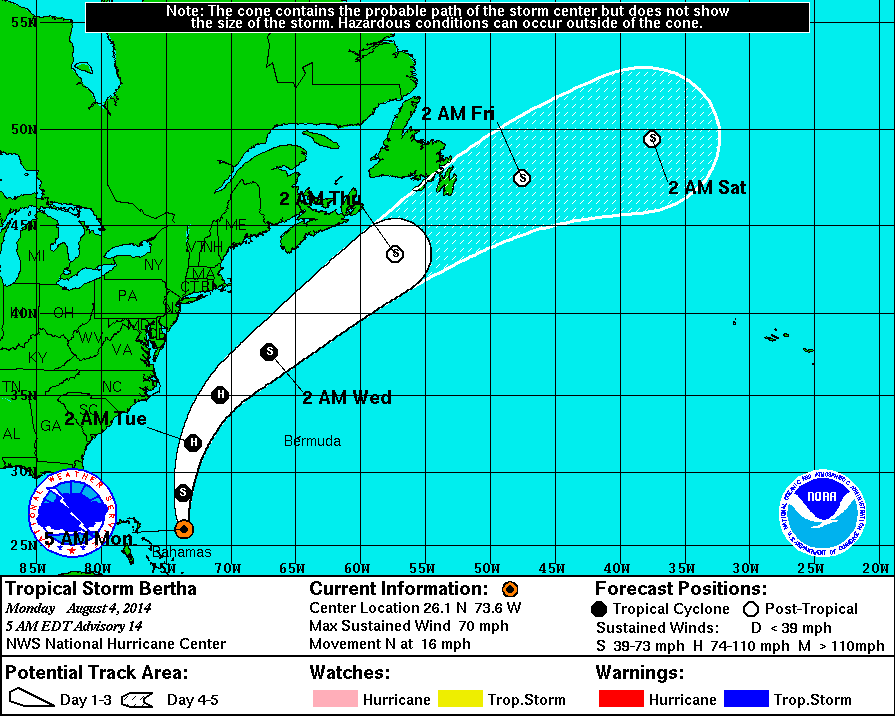
Tropical Storm Bertha became better organized and stronger overnight as shear decreased enough for more thunderstorms to wrap around it’s now closed surface center.  According to the National Hurricane Center,  maximum sustained winds have increased to 70mph and the central minimum pressure has fallen to 999mb. Bertha is now over very warm water and in an environment with less shear and dry air impeding further development. So it is likely to become a category 1 hurricane sometime today or tonight.

5amNHCtrackBertha has also turned north and will gradually turn to the northeast into the open Atlantic, ahead of upper-level trough over the Eastern US.  As the model consensus has been showing for days. The only impact from Bertha in tri-state area will likely be some high surf and rip currents along the shores as it makes it closest approach to our area sometime between Tuesday and Wednesday.  Then Bertha is expected to weaken and become a non-tropical system as it moves into the cooler waters of the North Atlantic, later this week.