Coastal Storm Wednesday Evening Update

This morning an inverted trough from coastal storm developing, gave New York City, Western Long Island and parts of New Jersey, some heavy rain and thunderstorms. A lull activity occuring for most of tri-state earlier this afternoon. But the coastal storm deepening and moving slower back to the coast this evening. Bands of rain with some embedded convection is now rotating back into Tri-State area.  Winds have been increasing has well, a little more than expected. Some coastal locations have sustained winds 20-30mph with gusts 30-40mph. Just east of the area, Block Island and Buzzard Bay have reported wind gust up to 45mph. Buoy south of LI have gusts to 49mph and 51mph. The highest winds are likely being brought down from aloft by thunderstorms, currently offshore. A cold pool aloft with this storm and as well warmer than normal sea-surface temperatures is enhancing instability near and off the coast. Radar has also detected rotation some of these thunderstorms today. Helicity along with instability may some waterspouts to form. But as these storm move closer to land, they have weakened somewhat, as they enter less unstable airmass.
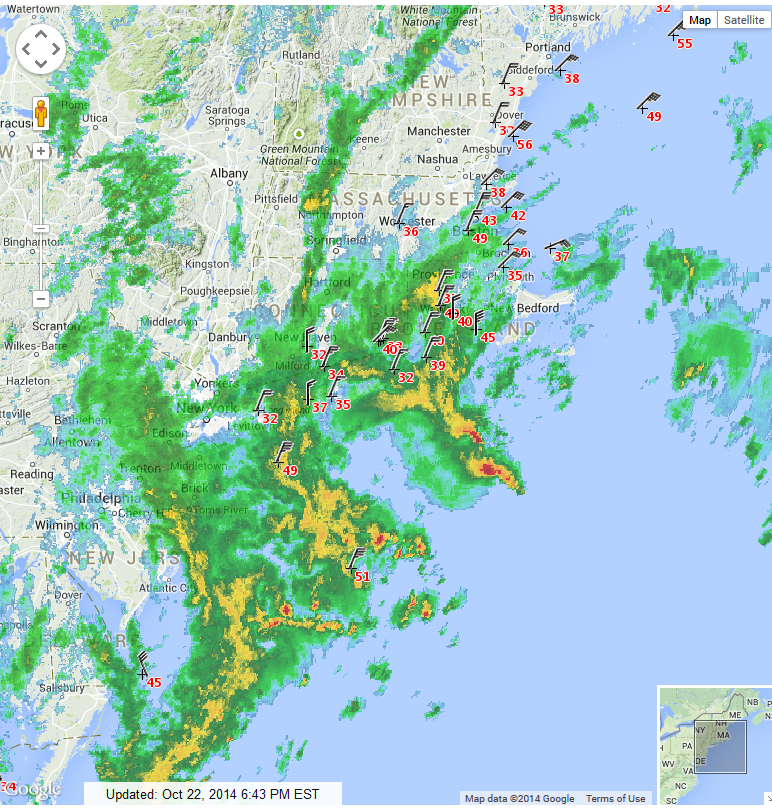
Surface wind, temps with radar overlaped at 6:43pm EDT

I expect bands of rain to continue to work their way inland from the ocean tonight and tomorrow. Some thunderstorms are still possible tonight. The 21z RAP shows 925mb winds at 40-50kt+ across coastal areas tonight. Heavy showers or thunderstorm could bring some of these winds down to surface, near the coast. Otherwise still not this storm, to much more than nuisance across the area. Tidal flooding should no be a\ issue along most coastal locations as winds are switching to the north and northwest. The only exception may be over parts of the north shore of Long Island or other north-facing shorelines.
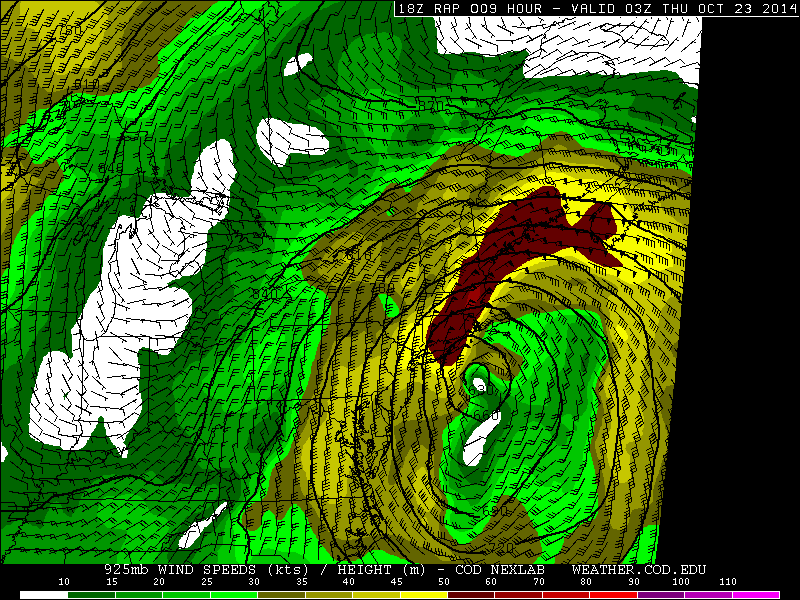
21z RAP from College Dupage Site
21z RAP from College Dupage Site show 40-50kt winds from New York City, Long Island northward

This storm will be weaken pull away from Thursday night and Friday. With slow clearing taking place. This weekend still appears to be mostly dry.
Cut-off Coastal Storm Impacts This Week

We had the chillest morning of the season so far. Temperatures got down into the lower 40s over New York City. While most of the suburbs dropped into 30s. Many part of the interior also saw their first frost or freeze of season. With a mixture of sunshine and clouds temperatures still rose into the upper 50s to near 60 this afternoon areawide, However, the weather will more unsettled after today. A cut-off low in upper-level of atmosphere will develop over the Northeast and  Mid-Atlantic regions on Tuesday. At the surface, an area of low pressure of Great Lakes will move southeast towards the northern Mid-Atlantic region and then merge with another area of low pressure developing south of Long Island on Wednesday. This low will begin slowly deepen, as it moves north into New England on Thursday.

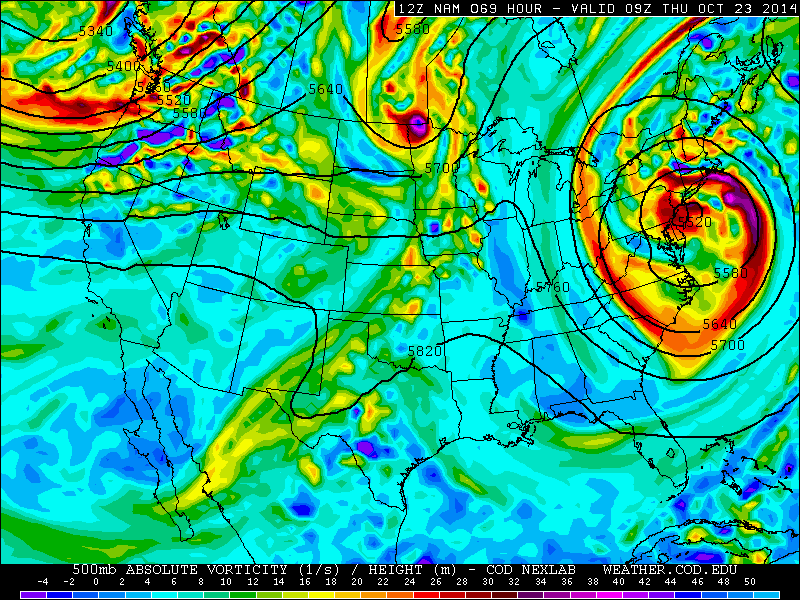
Closed/Cut-off Low over the East coast
Closed/Cut-off Low over the Mid-Atlantic coast n on the 12z NAM Model

Disturbances rotating around this low will trigger intermittent periods of rain in Tri-state area. On Tuesday some periods of rain and drizzle could start developing across the region by the late afternoon or evening hours and continue into the night. On Wednesday, more periods of rain are likely as this storm begins to consolidate and organize more south of Long Island. Some of the rain could heavy at times. But rain is likely to intermittent enough over next few days, to not cause any serious flooding issues. Rainfall totals will generally be somewhere between .50″ to 1.50″ for the entire area. But some spots may get less and more, depending on the banding. Winds will begin to increase from the north to northwest at 15mph to 25mph with gusts to 30mph near the coast on Wednesday. Periods of rain will likely continue into Thursday, as this storm will be close enough to impact the area.

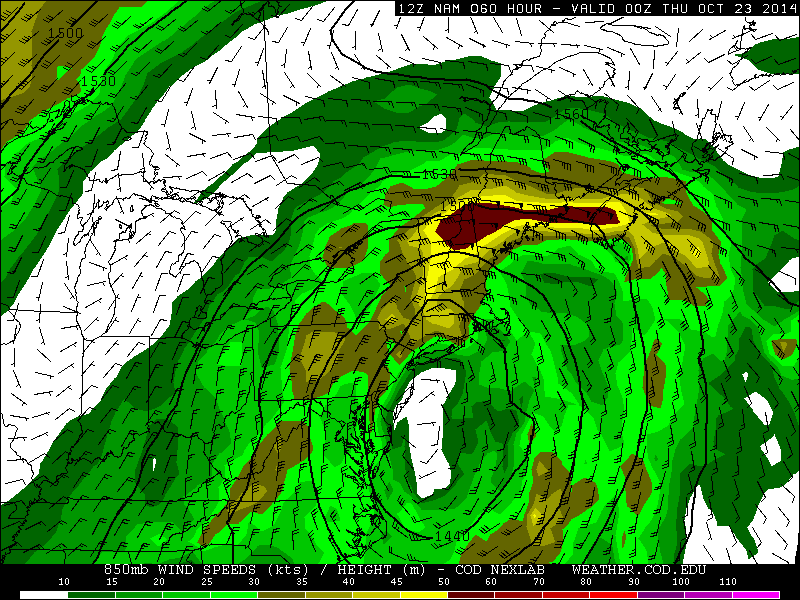
12z NAM model showing a 850mb 50kt+ easterly jet over parts of Northern New England.
12z NAM model showing a 850mb 50kt+ easterly jet over parts of Northern New England by Wednesday evening

Impacts along the New York, New Jersey and Connecticut coastlines appear to be minimal. Winds won’t be very strong or damaging, due to lack of a strong pressure gradient in the Tri-State area. Some minor tidal flooding is possible on Wednesday morning with initially out of northeast. Then those winds should increase out the north than northwest in the afternoon and evening. Preventing anymore tidal flooding afterwards. Overall, this storm appears to be more of nuisance for local Tri-state area. However, this is likely to be full-blown nor’easter for Northern and Central parts of New England. A tight gradient with stronger high pressure over SE Canada, will cause a stronger easterly jet off the ocean in this area. Which will enhance moisture and warm-air advection for heavy rainfall totals of 2-4 inches and wind gusts in excess of 40mph or 50mph, along their coastlines.

This storm will be affecting many parts of Northern Mid-Atlantic and Northeast for two or three days this week.  But another system coming out the Pacific, should help to kick this cut-off low out the area, in time for mostly sunny skies and seasonable temperatures over the weekend. For the next few days though, I will continue the monitor this storm, and give updates here or on twitter on any changes.

Major Hurricane Gonzalo Bears Down on Bermuda

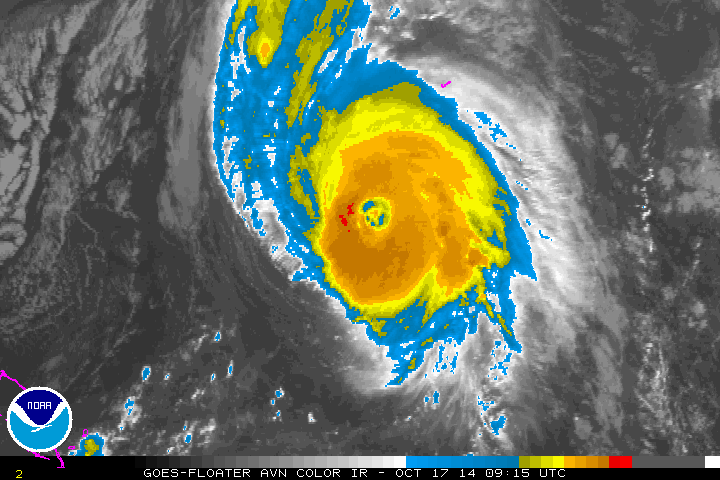
Hurricane warning remains in effect for Bermuda, as the island expects severe impacts from Hurricane Gonzalo. On Thursday, the storm restrengthened to category 4 hurricane with maximum sustained winds of 145mph. Then turned to north-northeast on a track towards Bermuda. This morning, Gonzalo is still a category 4 storm with maximum sustained winds decreased to 130mph. Over the past 12 hours, the hurricane has being undergoing an eyewall replacement cycle. This is where an outer eyewall forms and begins to replace the inner eyewall. During this cycle, some weakening typically occurs, until it’s complete.

avn0

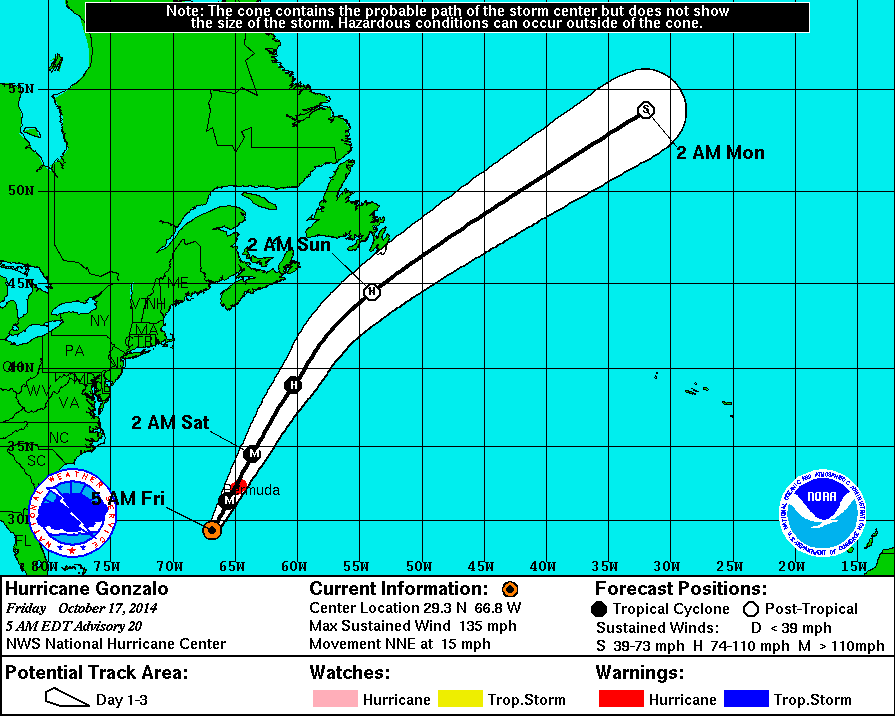
Gonzalo will be moving over cooler sea-surface temperatures later today. Upper-level shear is also increasing from a upper-level trough moving off the East Coast of the US.  So some further weakening is possible today and tonight. But Gonzalo still expected to remain a major and dangerous hurricane, while passing over or near the island of Bermuda this evening. Gonzalo is expected to bring heavy rains and winds over 100mph to Bermuda. According to the National Hurricane Center Gonzalo’s current forecast track will also create a significant storm surge for the island, that could rival the 10-foot surge produced by major Hurricane Fabian in 2003.

5am Friday National Hurricane Center forecast out to 3 days.
5am Friday National Hurricane Center forecast out to 3 days

Gonzalo will produce some swells along the East Coast through this weekend. As it moves by Bermuda then tracks more northeast into the North Atlantic. For the local area, Wave Watch model 6-12″ feet waves over the New Jersey and Long Island coastal waters on Saturday morning. Gonzalo will weaken further then transition to a post-tropical system by Sunday. Stay tuned for more updates here on this storm. Residents of Bermuda, should follow updates the National Hurricane Center for more updates system through tonight